A mobility scooter is a genuinely safe way to get about. But it is heavier and faster than walking, and it handles differently from anything most people have driven before.
The incidents we hear about are rarely dramatic. They're a kerb taken at the wrong angle, a tight turn at too much speed, or a driver reversing out of a drive who simply didn't look low enough. Here's what actually helps.
Before you go anywhere new
Practise somewhere quiet first. A car park on a Sunday, or a wide empty path. Get a feel for the turning circle, how quickly it stops, and how it behaves on a slope — before you need to know in traffic.
Every scooter is different. If you've changed machines, treat it as new even if you've driven scooters for years.
Kerbs and ramps
This is where more incidents happen than anywhere else.
- Approach straight on, at 90 degrees. At an angle, one wheel lifts before the other and the scooter can tip.
- Use dropped kerbs wherever they exist, even if it means going further along the road.
- Know your scooter's kerb limit and don't test it. It is usually smaller than people assume.
- Slow down before the kerb, not on it.
- On a steep ramp, go straight up or straight down — never across the slope.
On the pavement
On pavements you must be in the 4mph setting — walking pace. On a Class 3 scooter that's a legal requirement, not a suggestion.
- Give pedestrians room and slow right down when passing. You are the faster and heavier one.
- Be careful near shop doorways and blind corners, where people step out without looking.
- Watch for pedestrians wearing headphones — they won't hear you coming.
- Take extra care around children and dogs, both of which change direction without warning.
Crossing roads
- Use a crossing where there is one, even if it means a detour.
- Make eye contact with drivers before you commit. A driver who hasn't seen you may still pull out.
- Cross straight across, at the narrowest sensible point, and don't stop halfway.
- Be especially wary of vehicles reversing off driveways — a seated scooter user sits below the eyeline of many reversing drivers.
Being seen
Visibility is the single biggest factor in road safety on a scooter, and the easiest thing to improve.
- Use your lights in poor light, rain or fog — not just after dark.
- Bright or reflective clothing makes a real difference on a grey afternoon.
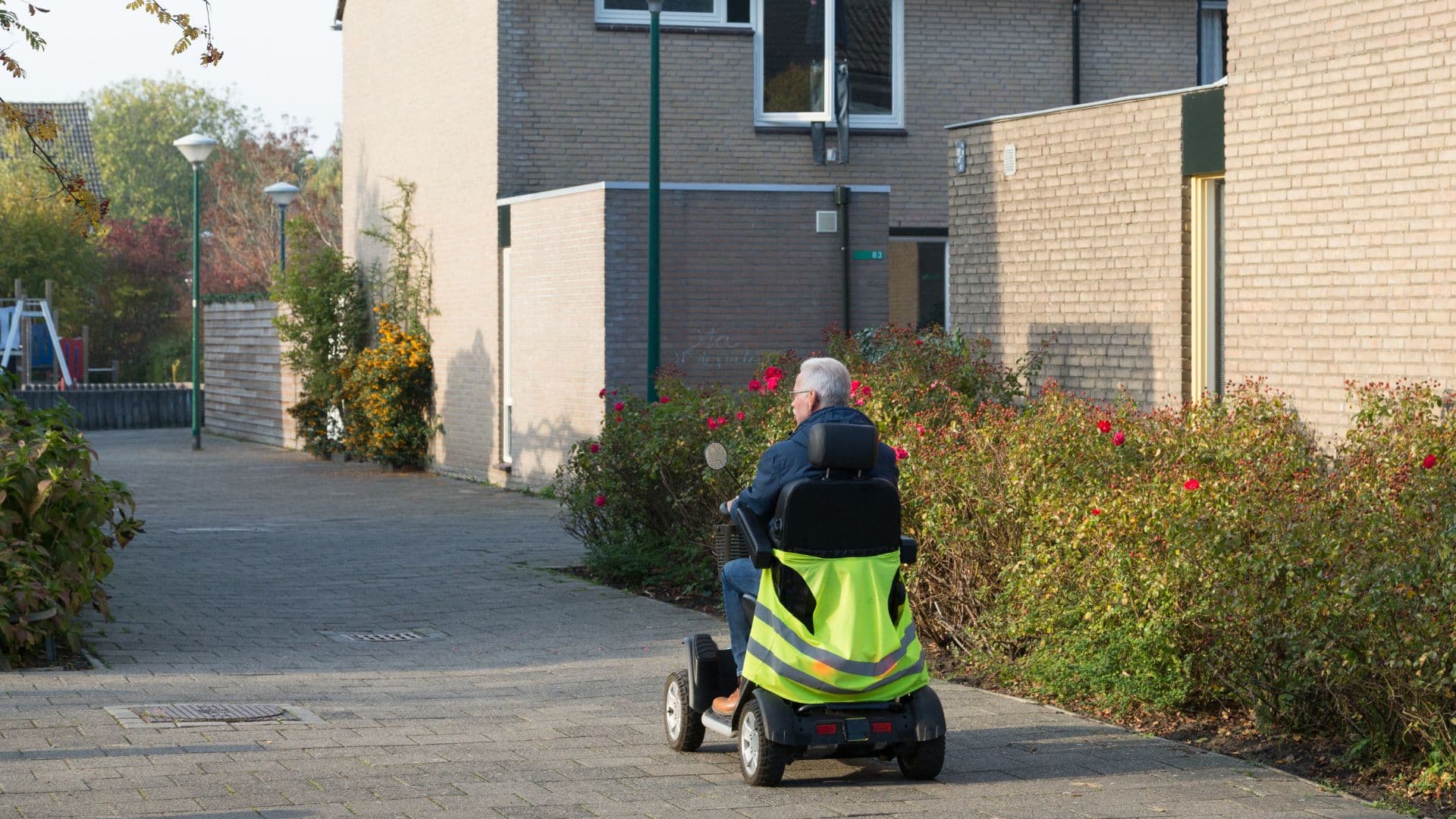
- A high-visibility cover or flag helps drivers pick you out.
- If you use a dual carriageway with a limit above 50mph, an amber flashing beacon is required — though it's generally better to avoid those roads.
Assume you have not been seen until a driver looks at you. It costs a couple of seconds and prevents the majority of near misses.
Speed, load and weather
- Slow down before turning, not during. Most tipping happens in a tight turn carried at too much speed.
- Don't overload it. Heavy shopping hung on the tiller changes the balance and the steering.
- Leave more room in the wet. Braking distances lengthen and painted lines and drain covers get slippery.
- In strong wind, be careful on exposed stretches — a side gust can shift a light scooter.
Keep the machine itself safe
A well-maintained scooter is a safer scooter. Brakes that hold on a slope, tyres with tread, working lights and healthy batteries are all safety items, not just comfort.
If something feels different — pulling to one side, a new noise, brakes that don't hold as they did — get it looked at rather than working around it.
The official rules are on GOV.UK, and worth a read whichever class you drive. To book a safety check, call us on 01234 267393.